
FINTECH, NEW ZEALAND, OPEN BANKING
NZ open banking for consumers - a primer.
Xero revolutionised the world of accounting with automated bank feeds so small business owners did not have to manually enter transactions into their accounting software. Now, open banking is live in New Zealand, paving the way for personal finance apps like Smoothy to use secure bank feeds and payments to provide innovation and choice in financial products and services.
What is open banking?
Open banking is part of new legislation requiring New Zealand banks to provide a secure way for customers to share their financial data with accredited apps. It’s designed to give consumers more choice over which products and services they use - this is a very good thing!
Open banking has been available in Australia and the US for several years. It launched in New Zealand in December 2025 as part of the Consumer Data Right (Customer and Product Data Act 2025). The open banking system is regulated by the government, and supported by all major New Zealand banks.
There are two ways that consumers can use their financial information with accredited service providers:
- 1.Account Information: a read-only view of transactions and balances, also known as bank feeds
- 2.Payment Initiation: one-off or recurring payments, also known as pay by bank
To use bank feeds or pay by bank in third-party apps, consumers must explicitly consent and authorise the actions through their bank’s mobile banking app.
What are bank feeds?
Instead of only being able to see financial data in their banking app, consumers can now securely connect their bank accounts to accredited apps to take advantage of easier, faster ways to manage their finances. Having the choice to do this safely is the key purpose of the open banking Consumer Data Right.
A common use of bank feeds is in personal finance and budgeting apps like Smoothy and PocketSmith. Transactions and account balances are automatically updated through the open banking API so users don’t have to import transaction data manually.
Security
Open banking is very secure - banks would not let customers connect their bank accounts to other apps if it wasn’t. Data shared via the open banking system is encrypted, and service providers who wish to offer open banking connections must be accredited by the Ministry of Business, Innovation and Employment (MBIE).
The new, official open banking system is much more secure than older online services that required users to pass their bank login details to a third party. With official open banking connections, users approve the connection inside their bank’s mobile app. The bank then issues an encrypted token that lets the app read the accounts selected, and nothing else. When users disconnect their bank feeds, the token stops working and the app can no longer access the data.
Benefits of open banking
Open banking benefits consumers, small businesses and enterprises.
- ■More innovation and competition in fintech, utilities and human services
- ■Improved accessibility and customer experience for consumers
- ■Increased choice over products and services
- ■Increased diversification and service switching
Ways to use open banking
Open banking is already used by 100+ New Zealand products and services including business applications like Xero, MYOB, Prosaic, Solo and Volley, and consumer apps like Sorted, Sharesies, Simplicity, PocketSmith and Smoothy.
As of August 2026, more than 26 million data sharing requests have been made through open banking in New Zealand, showing increased trust and adoption of open banking.
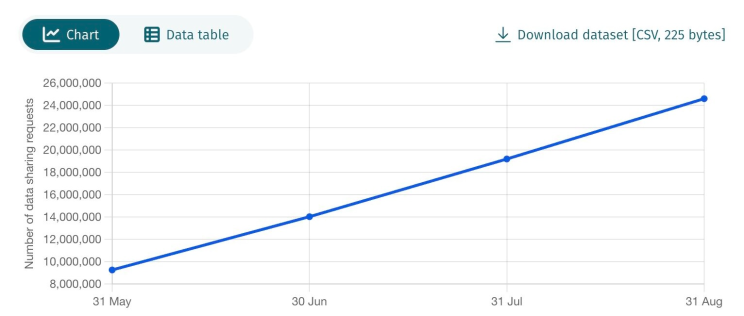
Source: Uptake of Consumer Data Right (MBIE)
Example: Smoothy app
Smoothy is a personal finance and productivity platform for consumers, developed by Product Sense. Smoothy uses bank feeds to create a personalised budgeting plan based on users’ transaction information, as well as payment initiation for one-off or recurring payments for paying bills, putting aside savings, topping up KiwiSaver accounts and more.
Once bank feeds are connected, in just a few minutes, Smoothy can:
- ■Detect recurring bills and subscriptions
- ■Predict upcoming expenses
- ■Group expenses into time buckets synced to users’ pay cycles
- ■Provide categorised spending insights
Like the majority of business and consumer apps using open banking in NZ, Smoothy uses Akahu to facilitate bank feeds and account connections. Akahu is an accredited data requestor, authorised by MBIE to act as an intermediary between banks and consumer apps, and apps that use Akahu must go through an accreditation process to demonstrate the necessary security standards and practices are in place.